humanoids
Retooling the Factory: The Brutal Economics of the Android Pivot
Tesla is tearing down its Model S and X lines for Optimus V3, but at a reported $60,000 per unit, the hardware still hasn't caught up to the software.
By Maya Chen, Humanoid Robotics · June 22, 2026 · 6 min read
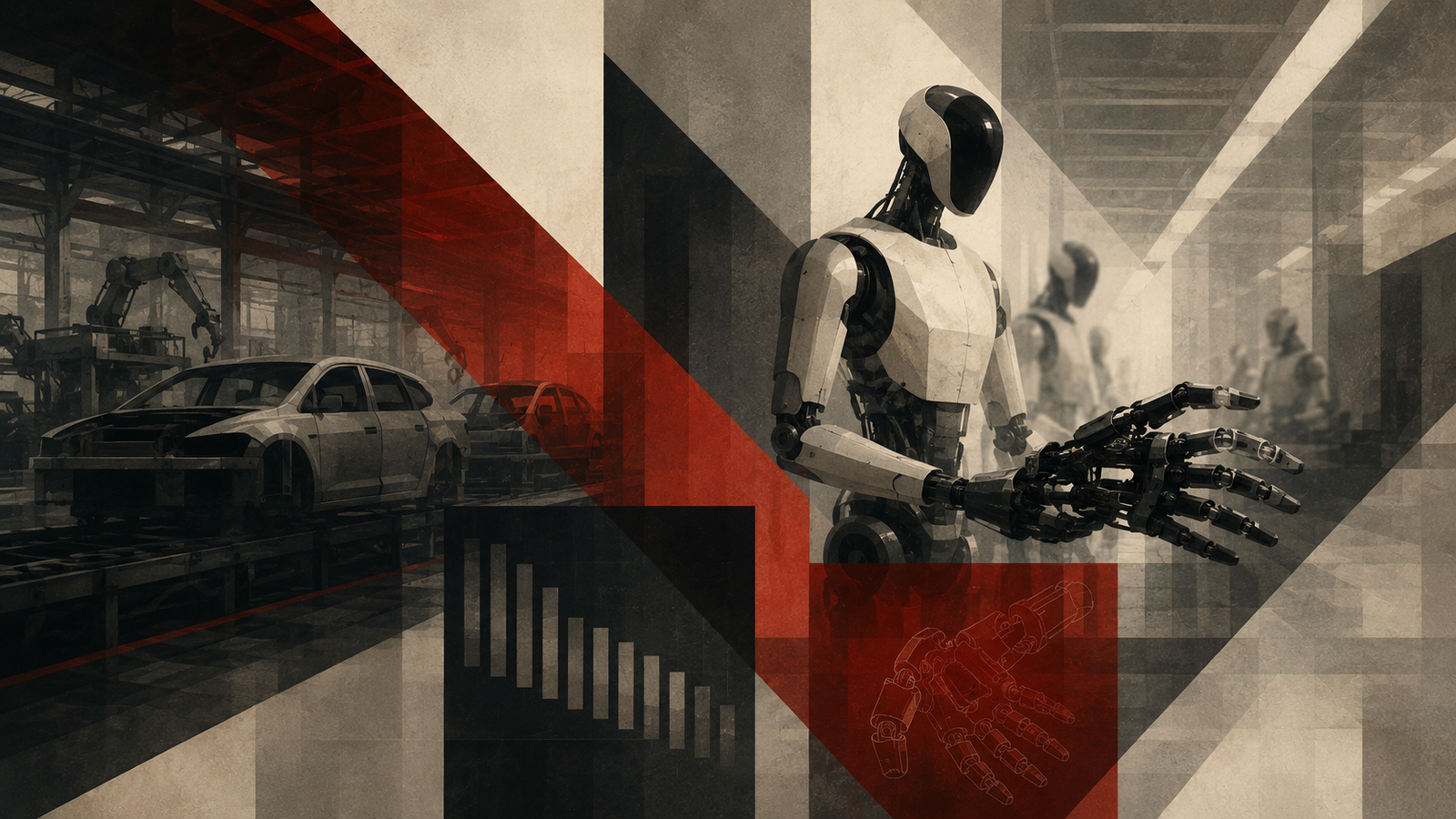
A factory floor mid-conversion from automotive assembly to humanoid robot production
For fourteen years, the Fremont factory line producing the Tesla Model S and Model X served as the beating heart of the luxury EV revolution. That era effectively ended in mid-June. Supply chain reports confirmed this week that Tesla has fully initiated the teardown of its flagship vehicle lines, repurposing the immense floor space into a dedicated mass-production facility for the Optimus V3 humanoid. The target for the initial production ramp is aggressively set for late July or August.
This is not a mere product update; it is an industrial metamorphosis. Transitioning a high-volume factory from automotive assembly to humanoid manufacturing is unprecedented. It also exposes the brutal, friction-heavy reality of physical AI: while software scales infinitely and cheaply, the mechanics of human dexterity remain stubbornly expensive.
The Friction of the Teardown
Tearing down a mature automotive production line to build robots is a gamble of historic proportions. The Model S and X, while aging, were reliable generators of high-margin revenue. Converting this space for Optimus requires an entirely new supply chain taxonomy.
Automotive manufacturing is defined by macro-precision: stamping massive steel panels, mating chassis to battery packs, and securing heavy suspension components. Humanoid manufacturing, conversely, is an exercise in micro-precision. The physical tolerances required to mass-produce 22-degree-of-freedom (DOF) bionic hands, integrate hundreds of tactile sensors, and route complex tendon-actuation systems demand clean-room-level assembly and entirely new calibration environments.
The machinery that built the Model S cannot build an Optimus. Fremont is effectively starting from scratch, trading a mature industrial process for an unproven, highly experimental assembly line.
The $60,000 Hardware Reality Check
The core of Tesla's pivot relies on a fundamental economic premise: that vertical integration and extreme volume can crush the unit cost of a humanoid robot. However, mid-June leaks from the Fremont supply base suggest that the internal cost to produce a single Optimus V3 unit still exceeds $60,000.
This figure lays bare the immense divide between Tesla's software supremacy and the unforgiving laws of hardware physics.
Tesla holds an undeniable moat in autonomous software. By leveraging its vast fleet of vehicles, the FSD computing architecture, and its massive neural network training infrastructure, the cognitive "brain" of Optimus is arguably the most advanced in the world. The marginal cost of copying an AI model into a new robot is effectively zero.
But a robot cannot manipulate the world with software alone.
| Component Cost Drivers | Automotive (Model 3/Y) | Humanoid (Optimus V3) |
|---|---|---|
| Actuation | 4 wheels, simple steering rack | 28+ body actuators, 22-DOF hands |
| Sensing | 8 exterior cameras, basic radar | Micro-tactile arrays, 6-axis force sensors |
| Computing | FSD Chip (1x per vehicle) | FSD Chip + low-latency edge nodes |
| Material | Cast aluminum, steel, glass | Carbon fiber, specialized polymers, custom alloys |
The mechanical hands alone represent an economic black hole. Achieving human-level dexterity requires dense sensor packaging and miniature, high-torque actuators that simply do not exist in traditional automotive supply chains. Until Tesla can manufacture these micro-components at the scale of millions, the $60,000 per-unit cost will remain a massive barrier to the $20,000 commercial price tag Elon Musk has promised.
The High-Stakes Race to Scale
Why sacrifice the Model S and X lines now, when the robot's unit economics are still inverted? Because in hardware, scale is the only escape velocity.
Tesla understands that waiting for the cost to drop before building the factory is a paradox; the factory is the mechanism that drops the cost. By forcing a high-volume manufacturing environment in Fremont, Tesla is applying extreme pressure to its supply chain to commoditize humanoid components just as it commoditized lithium-ion battery cells a decade ago.
This transition represents the crucible of physical AI. Over the next six months, the industry will watch closely to see if Tesla's automotive manufacturing expertise can successfully map onto the delicate, complex architecture of the human form. If Fremont can produce the Optimus V3 at volume while slashing that $60,000 cost, it will trigger the commercial dawn of humanoid labor. If they stall, it will prove that replicating human dexterity is a mechanical ceiling that even the world's most aggressive manufacturer cannot easily break.
More From Robotics Weekly


Part of Issue 2: The Reckoning, published June 22, 2026→