humanoids
The Form-Factor Fallacy: Why the Next Robotic Revolution Won't Be Humanoid
Genesis AI's $105 million bet on a wheeled robot named Eno suggests the humanoid form factor was never an engineering necessity, just expensive theater.
By Maya Chen, Humanoid Robotics · June 22, 2026 · 6 min read
A wheeled robot with an articulated tower and dexterous hands working a warehouse aisle
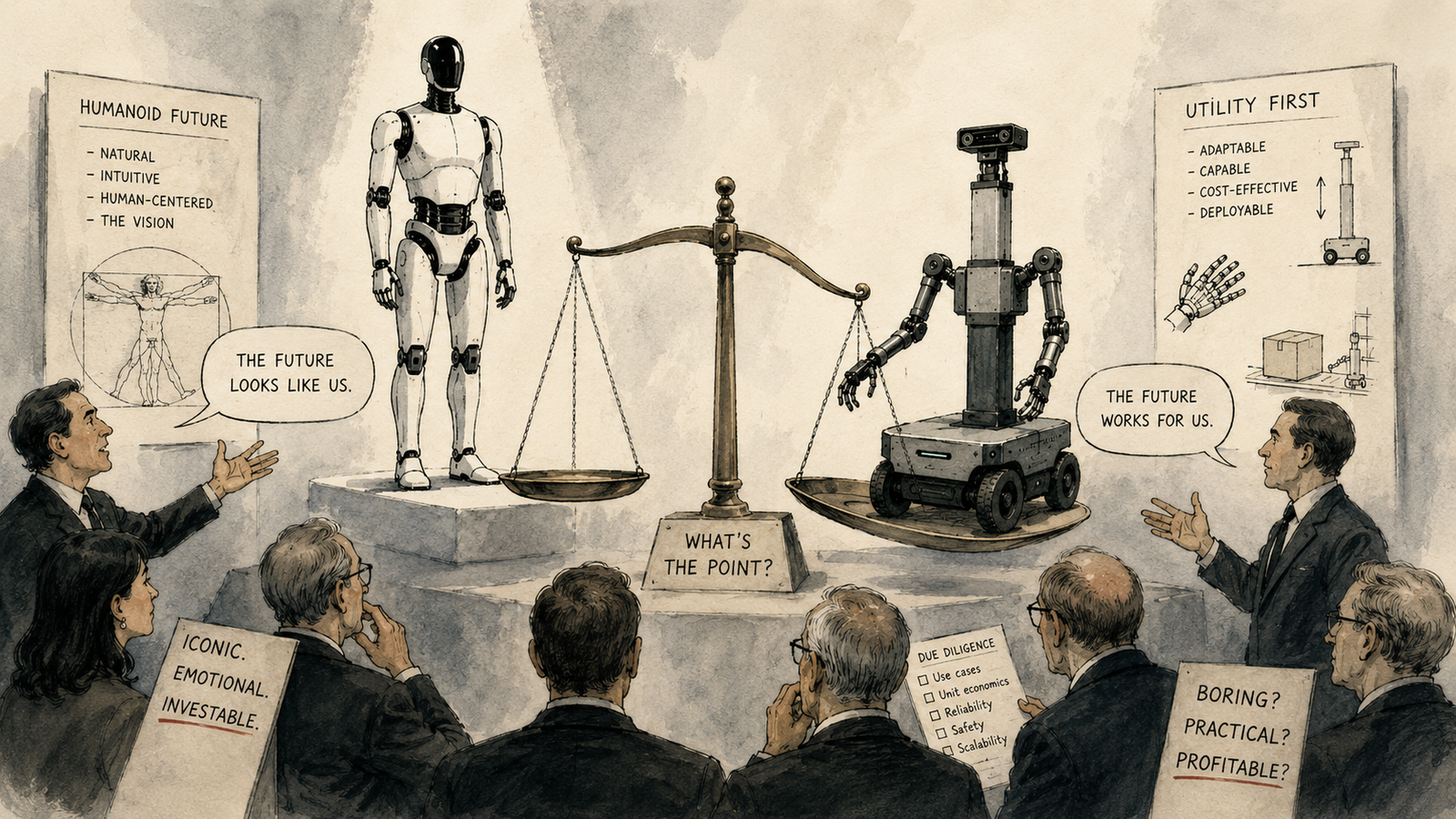
The optics of the robotics gold rush have, until now, been dominated by a singular, seductive silhouette: the human mirror. For the past three years, venture capital has poured relentlessly into bipedal humanoids. We have been told, in press releases and heavily edited demo videos, that because the world was built by humans, for humans, the ultimate physical artificial intelligence must necessarily be cast in our image.
Then came the third week of June 2026.
The unveiling of "Eno" by the French robotics upstart Genesis AI, packaged alongside a staggering $105 million seed round led by former Google chief Eric Schmidt, marks a critical structural pivot in the physical AI landscape. Genesis didn't build a humanoid. Eno is a pragmatist's machine: a robust, wheeled omnidirectional base, an adjustable vertical tower, and an incredibly sophisticated pair of proprietary hands boasting 20 degrees of freedom.
It is a massive, highly capitalized bet against the humanoid consensus. More importantly, it exposes the humanoid form factor for what it currently is: an expensive marketing strategy masquerading as an engineering necessity.
The Tax of the Two-Legged Stance
To understand why Genesis's $105 million round is a watershed moment, one must look at the brutal physics of robotic locomotion. The human bipedal stance is an evolutionary miracle, but as a mechanical blueprint for industrial efficiency, it is an absolute catastrophe.
When a humanoid robot stands still, it is not actually resting. It is engaged in a continuous, computationally expensive dance of micro-adjustments, dynamic balancing, just to avoid falling over. Actuators are firing, sensors are processing data at hundreds of hertz, and batteries are draining, all before the machine has even begun to perform a useful task.
When you add the requirement of traversing a concrete factory floor or a smooth hospital corridor, the absurdity compounds. A bipedal robot must lift its entire body weight with every step, fighting gravity and absorbing kinetic shock through complex, failure-prone knee and ankle joints.
Eno, by contrast, bypasses this entire computational and mechanical tax via a wheeled base. Wheels are mathematically elegant. They require zero energy to maintain static balance. They offer smooth, high-velocity transit across standard industrial floors, and they leave the robot's entire compute budget free to focus on what actually matters: semantic understanding and manipulation.
By refusing to pay the "humanoid tax," Genesis has built a machine that can likely operate longer, move faster, and cost significantly less to manufacture than any bipedal competitor.
       TYPICAL HUMANOID STACK               GENESIS AI "ENO" STACK
┌──────────────────────────────────┐     ┌──────────────────────────────────┐
│  High-Level Spatial Reasoning    │     │  High-Level Spatial Reasoning    │
├──────────────────────────────────┤     ├──────────────────────────────────┤
│  Dexterous Manipulation (Hands)  │     │  Dexterous Manipulation (Hands)  │
├──────────────────────────────────┤     ├──────────────────────────────────┤
│ 40%+ Compute & Battery Dedicated │     │ 95%+ Compute & Battery Dedicated │
│ to Dynamic Bipedal Balancing     │     │ to Real-World Productivity       │
└──────────────────────────────────┘     └──────────────────────────────────┘
The Anthropic Illusion
Why, then, have tech giants and elite VCs been so deeply intoxicated by the humanoid form? The answer lies in a psychological phenomenon we might call the Anthropic Illusion.
Human beings are hardwired for empathy and anthropomorphism. We project intelligence onto things that look like us. A robotic arm bolted to a factory floor is viewed as an appliance; a two-legged machine that walks through a door is viewed as a peer. For a robotics startup seeking to raise hundreds of millions of dollars in a crowded market, the theatrical value of a humanoid is unparalleled. It commands headlines, dominates social media algorithms, and satisfies the sci-fi fantasies of tech billionaires.
But vanity is a poor foundation for industrial scaling. The argument that "the world is built for humans, so robots must be human" crumbles under light scrutiny. Our world features stairs, narrow doorways, and high shelves. A wheeled base with a telescoping vertical column, like Eno's, can navigate doorways just as easily, and it can reach a 10-foot shelf by simply extending its spine, without the inherent tipping hazard of a humanoid standing on its tiptoes.
The only environment where a humanoid form is truly non-negotiable is one explicitly designed to exclude alternative mechanics, such as navigating a submarine ladder or squeezing into a highly specific airplane cockpit. In the vast majority of retail, logistics, manufacturing, and domestic spaces, a hybrid form factor is not just sufficient; it is vastly superior.
The True Frontier: Dexterity Over Anatomy
The real genius of the Genesis AI strategy lies in where they chose to spend their capital. They didn't waste millions perfecting a mechanical hamstring. Instead, they focused their engineering entirely on the true bottleneck of physical AI: dexterous manipulation.
Physical AI models (like vision-language-action models) have advanced to the point where a robot can easily understand what a coffee mug is, where it is in space, and that it needs to be picked up. The breakdown happens at the physical interface. Most industrial robots use rudimentary parallel grippers, clumsy two-pronged claws that lack the nuance to handle delicate, irregularly shaped, or soft objects.
By equipping a stable, wheeled tower with 20-degree-of-freedom hands, Eno targets the actual point of economic value. The value of a robot is not derived from how it gets to the table, but from what it can do once it arrives. A robot that rolls to a workstation and folds laundry, sorts electronic waste, or kits medical supplies with human-like dexterity is infinitely more valuable than a humanoid that walks beautifully to the workstation but can only clumsily pinch objects with a three-fingered mitt.
A Market Correction in Real Time
The Genesis AI seed round is the first major sign of a market correction that was long overdue. As the initial euphoria of the physical AI boom gives way to the harsh realities of unit economics, deployment velocity, and mean time between failures, the humanoid romance will inevitably fade.
Corporate buyers do not care about the poetry of the human form. They care about throughput, uptime, and return on investment. When the spreadsheets are finalized, a machine that spends half its battery life merely staying upright will struggle to compete with a highly focused, structurally optimized platform that devotes its entire mechanical and digital existence to the task at hand.
Eric Schmidt's $105 million bet on Eno is a clear signal to the industry: it is time to stop building robots that look like us, and start building robots that work for us. The future of physical AI will not be walked in on two legs; it will roll in on wheels, quietly, efficiently, and without the need for applause.
More From Robotics Weekly


Part of Issue 2: The Reckoning, published June 22, 2026→