humanoids
A Grounded Reality Check: The Friction of the Factory Floor
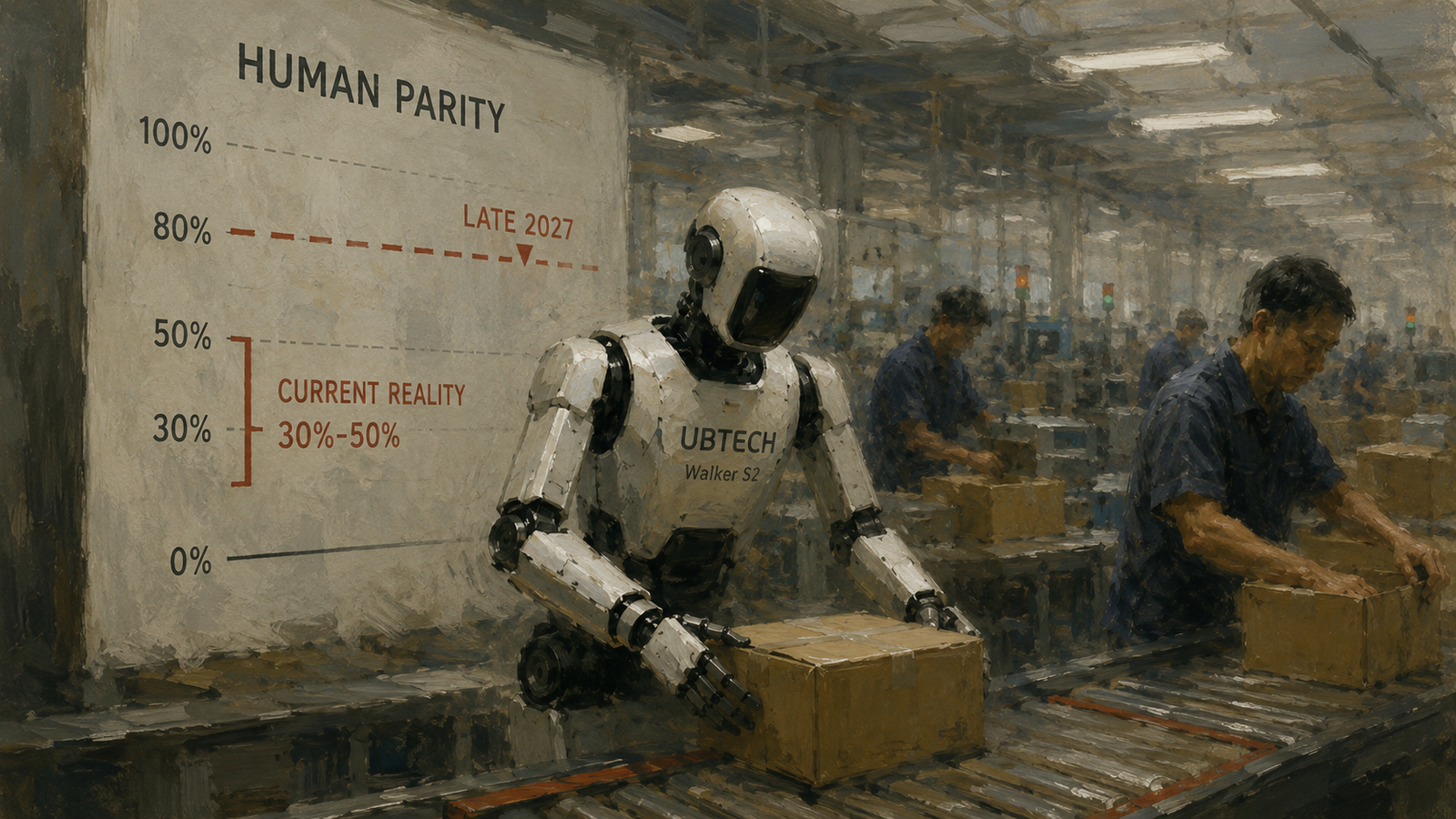
UBTECH's admission that its Walker S2 humanoid runs at 30–50% of human speed isn't a failure, it's the most honest data point the industry has produced yet.
By Maya Chen, Humanoid Robotics · June 22, 2026 · 6 min read
A humanoid robot working a case-packing station on a factory floor
The robotics industry has a serious reality distortion problem. For the past three years, the public timeline of physical AI has been charted not in peer-reviewed papers or audited production metrics, but in heavily edited, two-minute social media videos. We watch humanoids fold shirts, sort blocks, and execute backflips in sterile, highly controlled laboratories. It looks frictionless. It looks imminent.
Then came the June 15 report from the Financial Times. In a refreshing and necessary departure from the industry's hype cycle, UBTECH Robotics candidly admitted that its much-touted Walker S2 humanoid, currently undergoing pilot deployments in automotive and logistics facilities, operates at roughly 30% to 50% of the speed and efficiency of a skilled human worker in tasks like case-packing and inspection.
This is not a failure of engineering. It is the sobering, unvarnished truth of where physical AI currently stands. By admitting that their flagship model won't hit even 80% human parity until late 2027, UBTECH has done the entire sector a favor: they have reset the clock on the automation timeline.
The Anatomy of a Viral Illusion
To understand the 30% efficiency metric, we must first deconstruct the 100% illusion sold to investors.
When a humanoid robot performs a flawless manipulation task on camera, viewers rarely see the scaffolding required to make it happen. The laboratory environment is rigidly mapped. Lighting is optimized to prevent computer vision glare. The objects to be manipulated are uniform in weight and texture, and their coordinates are often known to the millimeter. In many cases, the fluid dexterity shown is heavily assisted by human teleoperation, or the video is simply sped up to mimic biological speed.
The gap between a successful laboratory demonstration and a viable commercial deployment is not an increment; it is an entirely different engineering discipline.
The Chaos of Case-Packing
Compare the pristine laboratory to the environment where the Walker S2 is actually being tested: a live factory floor.
Industrial environments are inherently hostile to nascent AI. A case-packing station is an exercise in dynamic chaos. Boxes arrive slightly misaligned on the conveyor. Tape snags. Lighting shifts as bay doors open and close. A human worker adjusts to these micro-anomalies instantly, utilizing deep spatial intuition and advanced tactile feedback to re-grip a slipping object without breaking rhythm.
For a machine, despite the Walker S2's impressive 52 degrees of freedom and bionic hands, every physical anomaly requires a computational cascade. The robot's vision-language-action (VLA) models must identify the error, calculate a new trajectory, verify physical constraints, and execute the correction. This cognitive latency is where the efficiency bleeds out. While a human is already taping the box, the robot is still computing the physics of the dropped cardboard flap. At 30% to 50% human speed, the humanoid is effectively operating in slow motion.
Reevaluating the Economics of Automation
Does a machine operating at half the speed of a human destroy the economic thesis for physical AI? Not necessarily, but it radically alters the deployment math.
The immediate value of early-stage humanoids isn't throughput speed; it is uptime and consistency. A robot operating at 40% efficiency for 22 hours a day (accounting for autonomous battery hot-swaps) can theoretically process a volume comparable to a human working a standard shift. However, this equation only balances if the capital expenditure and maintenance costs of the robot are heavily suppressed, a reality that the hardware supply chain is still fighting to achieve.
Furthermore, operating at a deficit to human capability completely changes how these machines must be integrated. They cannot simply be dropped into existing workflows as 1:1 human replacements. Production lines will need to be temporarily buffered or parallelized to accommodate the slower throughput of robotic nodes, introducing friction into "just-in-time" manufacturing chains that were explicitly designed around human reflexes.
The Long Road to 2027
UBTECH's timeline targeting 80% parity by late 2027 is ambitious, but it is grounded in measurable technological vectors. Closing that 50% gap will not come from building stronger actuators or making the robot physically faster. It will come entirely from reducing cognitive latency.
Three specific breakthroughs are required to hit that 2027 target:
- Edge-Compute Acceleration: Moving heavy neural inference directly onto the robot's internal hardware to eliminate the millisecond delays of querying off-board server clusters.
- Tactile Foundation Models: Advancing sensory feedback loops so the robot does not rely solely on its binocular RGB cameras to understand if it has a firm grip on an object.
- Failure Recovery Heuristics: Training models not just on how to perform a task perfectly, but on how to rapidly and autonomously recover when the physical environment shifts unexpectedly.
UBTECH's candidness should not be misread as pessimism. It is the necessary maturation of an industry transitioning from R&D theater to commercial reality. The age of physical AI has undeniably arrived, but as the Walker S2 metrics demonstrate, the future will not be ushered in by flawless, frictionless androids. It will be built by methodical machines, grinding through the chaotic reality of the physical world, one delayed calculation at a time.
More From Robotics Weekly

Part of Issue 2: The Reckoning, published June 22, 2026→