robotics-funding
The Bellwether IPO: What Seer's Hong Kong Listing Says About Physical AI
Shanghai Seer's $1.4 billion Chapter 18C listing is the first real public-market stress test for robotics, and it's betting on infrastructure, not humanoid theater.
By Daniel Osei, AI Infrastructure & Robotics Markets · June 22, 2026 · 5 min read
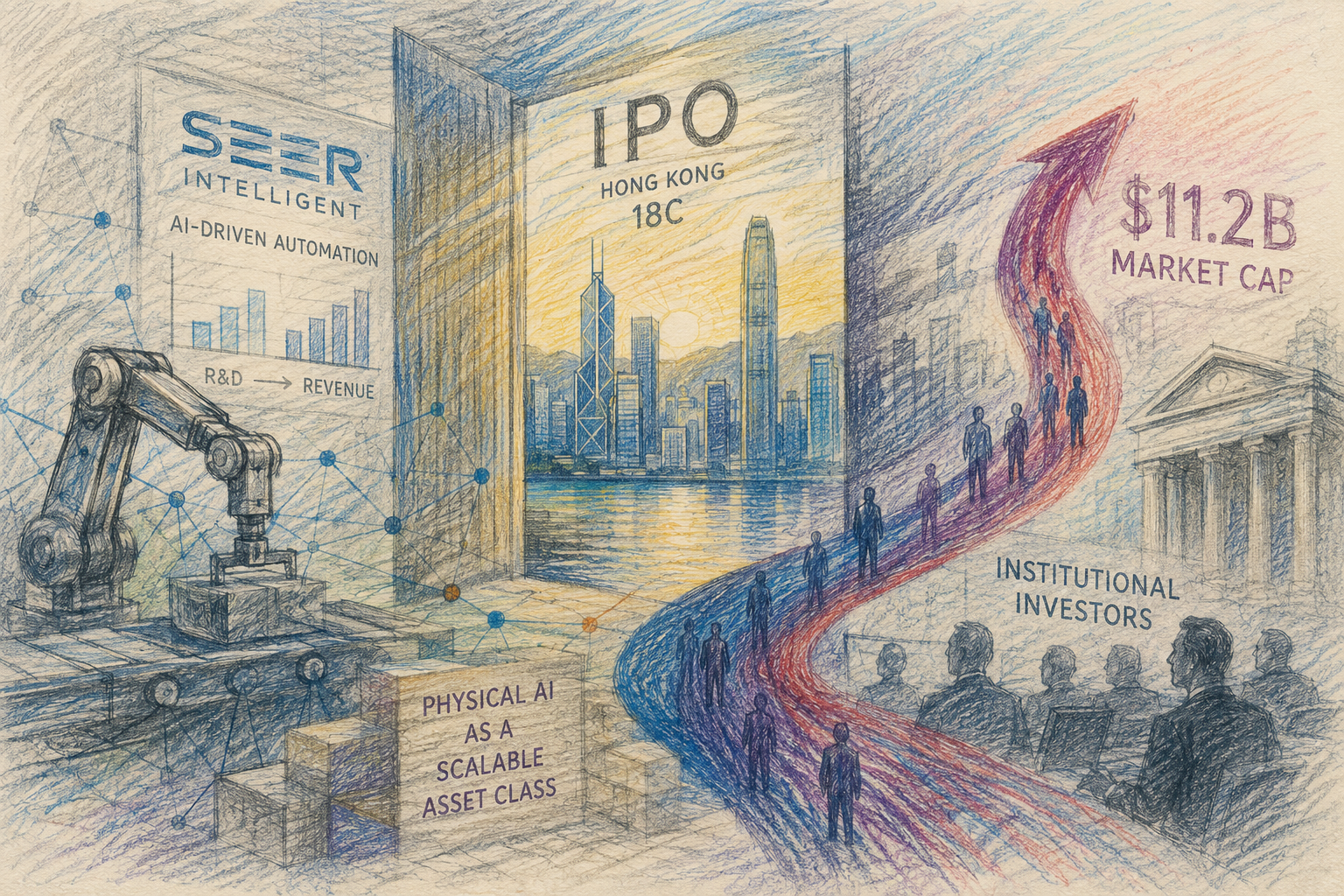
A trading floor display showing a robotics company's IPO pricing in Hong Kong
The timeline of technological revolutions is rarely marked by laboratory breakthroughs alone; it is marked by the moment capital markets decide those breakthroughs are bankable.
Between June 15 and June 18, 2026, the application window for Shanghai Seer Intelligent Technology's initial public offering opened on the Hong Kong Stock Exchange. Offering shares at HK$101.60 and targeting a market capitalization of roughly HK$11.2 billion ($1.4 billion USD), Seer isn't just executing a liquidity event. Under the HKEX's specialized Chapter 18C listing rules, this IPO represents the first true public market stress test for advanced, scalable physical AI.
The robotics sector has spent the last three years thriving on venture capital, a funding mechanism that tolerates speculative timelines and laboratory-grade demo videos. But public equities require a different calculus. By stepping onto the main board, Seer is signaling that the era of treating physical AI as an experimental novelty is over. It is now a mature asset class.
From Speculation to Revenue Generation
What separates Seer from the crowded landscape of humanoid startups fighting for headlines is its brutal pragmatism. While competitors are still trying to perfect the bipedal gait of generalized androids, Seer built a fortress around the "robot brain."
The company has ranked first globally in intelligent robot controller shipments for three consecutive years. They didn't build the most viral robot; they built the operating system and control hardware that allows thousands of disparate robots to function autonomously in complex industrial environments.
This is the transition from R&D theater to robust revenue generation.
| Metric | Venture-Backed Humanoid Startups | Seer Intelligent Technology (Pre-IPO) |
|---|---|---|
| Core Product | Prototype hardware and VLA models | Standardized controllers, AMRs, and fleet software |
| Deployment Scale | Pilot programs (10–50 units) | 2,000+ models across 35 countries |
| Financial State | High-burn R&D, minimal revenue | Scaling commercial revenue, predictable margins |
| Market Strategy | Vertical integration (build everything) | Horizontal integration (power everyone) |
By focusing on the unified platform layer, enabling a closed loop of environmental perception, autonomous decision-making, and action execution, Seer has tapped into immediate commercial demand across electronics, automotive, and biopharmaceutical manufacturing. Institutional investors aren't buying the promise of a sci-fi future; they are buying the infrastructure currently automating the global supply chain.
The Chapter 18C Validation
The mechanics of this listing are just as important as the company itself. Introduced to facilitate the capitalization of "Specialist Technology Companies," Chapter 18C is the HKEX's bridge for deep-tech firms that require massive, sustained R&D investment but may not yet meet traditional, profit-based listing criteria.
By utilizing this pathway, Seer is proving that the massive capital requirements of embodied intelligence can be sustained by public markets.
Before this dashboard visualizes the financial mechanics, consider the implications: eight cornerstone investors, including institutional heavyweights like Hillhouse Group, committed to nearly HK$462 million of the IPO shares. This isn't speculative retail trading; it is a calculated bet by sovereign and institutional funds that physical AI is the next foundational layer of industrial infrastructure.
Chapter 18C lowers the immediate revenue burden but demands intense R&D thresholds. It forces public markets to adopt the long-term horizon previously reserved for venture capital, specifically tailored for the extended hardware cycles of robotics.
The Bellwether for Physical AI
Seer's $1.4 billion valuation target sets a critical benchmark. If the stock holds or appreciates upon its June 24 trading debut, it will validate the entire physical AI supply chain. It signals to private markets that there is a viable, high-valuation exit strategy for embodied intelligence platforms that can prove real-world utility.
More importantly, it draws a stark line in the sand for the robotics industry. The honeymoon phase of physical AI is concluding. From this week forward, the market will increasingly demand less poetry about humanoid form factors, and more audited revenue from the factory floor.
More From Robotics Weekly


Part of Issue 2: The Reckoning, published June 22, 2026→