vla-models
The Tactile Missing Link: Why Vision and Language Aren't Enough for Embodied AI
RobOmni, the industry's first tactile-sensing benchmark from Daimon Robotics and Galbot, exposes the grounding bottleneck inside vision-language-action models.
By Maya Chen, Humanoid Robotics · June 21, 2026 · 5 min read
A robotic hand fitted with tactile sensors gripping a fragile object
For the past three years, the robotics industry has been intoxicated by the promise of Vision-Language-Action (VLA) models. The prevailing theory was elegant in its simplicity: feed a neural architecture enough video data of human manipulation, pair it with natural language instructions, and the system will naturally extrapolate the physics of the real world.
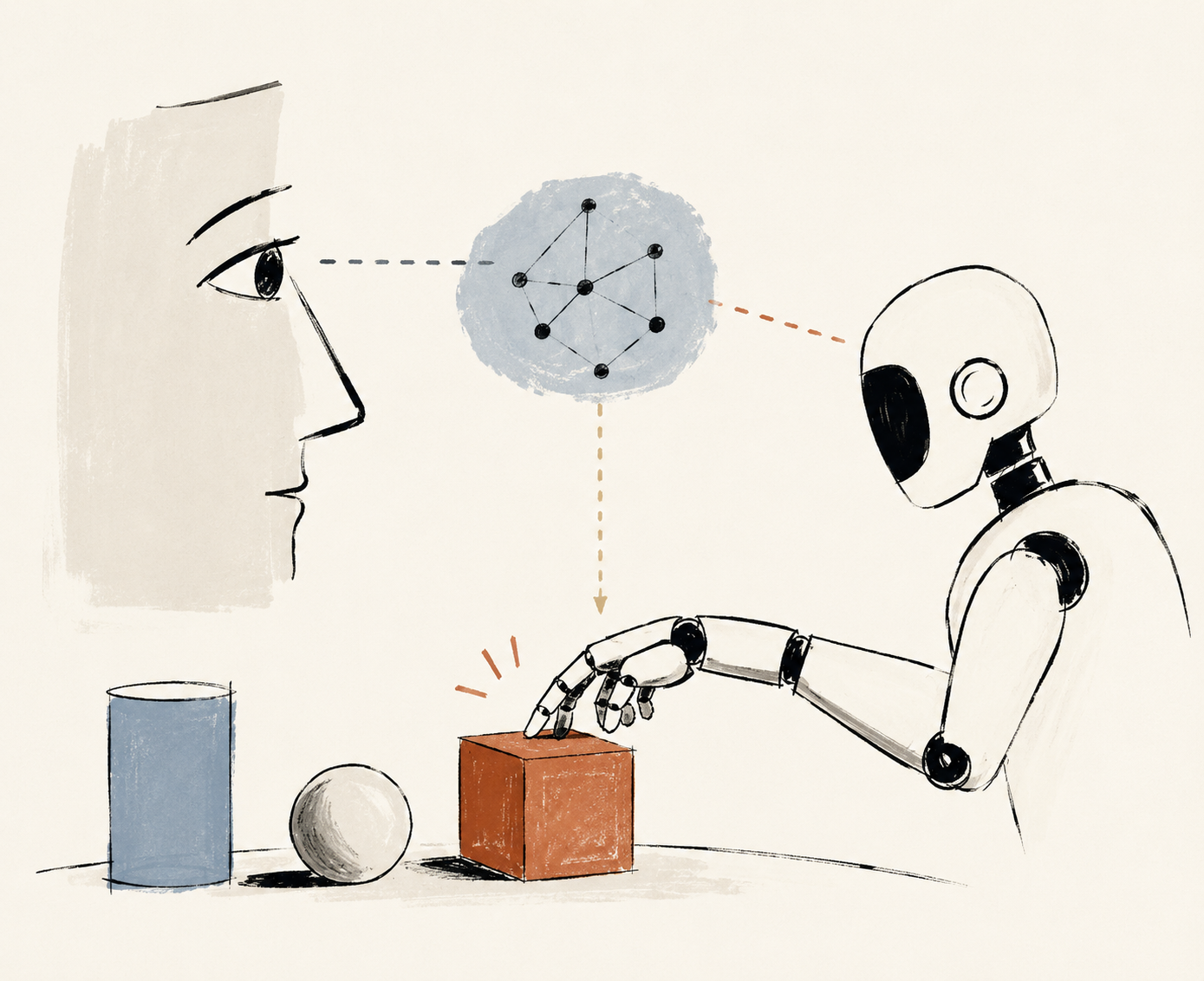
However, as deployment scales have grown, a harsh physical reality has set in. Vision and language are fundamentally passive modalities. They are excellent for macro-navigation and task sequencing, but they fail at the millimeter scale. When a robotic end-effector actually makes contact with an object, the camera's view is inevitably occluded, and language becomes far too abstract to govern the rapid, high-frequency micro-adjustments required to keep a glass from slipping or an egg from crushing.
This is the "grounding bottleneck", the chasm between theoretical understanding and physical execution. And as of June 8, 2026, the industry finally has a formalized map to cross it.
The RobOmni Paradigm Shift
At this year's symposiums, Daimon Robotics and Galbot unveiled RobOmni, officially the industry's first omni-modal evaluation benchmark explicitly built around high-fidelity tactile sensing.
Prior to RobOmni, benchmarks heavily favored visual acuity and semantic understanding. We were testing how well a robot could see a tool and understand what it was for, rather than how well it could feel the tool slipping from its grasp. RobOmni completely flips this paradigm by introducing a rigorous, first-principles framework to evaluate how models translate physical contact data into real-time action.
Key components of the new benchmark include:
- Multi-Vector Slip Detection: Evaluating a model's latency in detecting and correcting micro-slips before visual sensors can register the drop.
- Variable-Density Grasping: Scoring the system's ability to adjust grip force dynamically when transitioning from rigid to deformable materials without relying on visual cues.
- Occluded Manipulation Tasks: Forcing VLA models to complete assembly tasks entirely by touch after an initial visual scan, simulating real-world manufacturing environments where sightlines are compromised.
Closing the Perception-to-Action Loop
The introduction of RobOmni is more than just a new set of tests; it is a forced evolution for the entire sector. By creating a standardized metric for tactile feedback, Daimon and Galbot have provided the explicit target that hardware and software teams need to align their development cycles.
For engineering teams currently pushing the limits of advanced VLA architectures, such as the X1-D platforms, this signals a critical pivot. We are moving away from an era of "embodied AI" that simply acts as a physical manifestation of a chatbot, and toward a future of true physical grounding.
If a robot cannot feel the world, it cannot truly interact with it. RobOmni ensures that the next generation of humanoid and industrial robotics will finally possess the tactile vocabulary required to master dexterous manipulation. The grounding bottleneck is finally beginning to break.
More From Robotics Weekly



Part of Issue 1: The Humanoid Tipping Point, published June 21, 2026→